
A floor that creaks more than before, a door that suddenly rubs against the ground, a slight dip noticeable underfoot: these signs often go unnoticed for months, sometimes years. Knowing whether a floor is at risk of collapsing requires correctly reading these signals, understanding what is happening beneath the surface, and taking action before the structure becomes irreparable.
Moisture and dry rot: the invisible degradation of joists
Competitors address visible signs (cracks, slopes, sticking doors) without detailing the most common degradation mechanism in old wooden floors. Water infiltration, leaks from buried networks, and rising damp weaken the joists long before a dip appears on the surface.
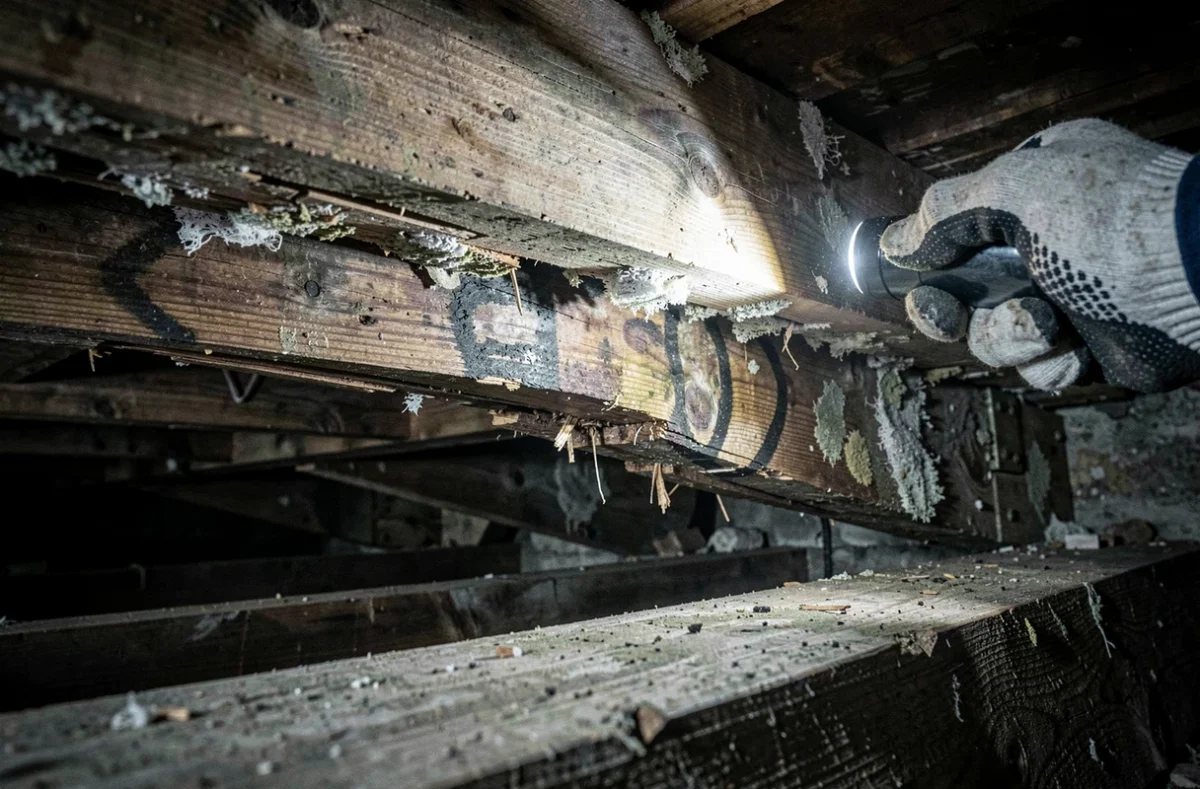
Standing water in a crawl space or an undetected leak under a floor creates an environment conducive to dry rot and wood-destroying fungi. Dry rot can destroy a load-bearing joist in just a few months if the conditions of humidity and confinement are met. The wood then loses its load-bearing capacity without the surface covering showing any obvious signs.
Noticing a persistent musty smell in a room, observing brown discoloration or whitish filaments on beams accessible from a basement or cellar is a warning signal that should not be delayed. In the absence of treatment for the source of moisture, no mechanical reinforcement of the floor will last over time.
When trying to assess whether a floor can collapse, the first check should always concern the moisture condition of the structure, not just the appearance of the floor.
Cracks in walls and ground subsidence: reading the real severity
A single crack on an interior wall does not necessarily indicate a floor problem. However, multiple diagonal cracks around openings (doors, windows) signal structural movement that may involve the floor, the foundations, or both.
The width of the crack matters less than its evolution. A thin crack that widens week by week indicates active disorder. The clay prevention fund indicates that a drop of more than two centimeters on a flat surface and cracks wider than three millimeters with vertical displacement constitute serious alert thresholds.
Differentiating an old defect from an evolving movement
In old houses, a slightly sloped floor may result from settling that has stabilized for decades. This type of defect, if it is no longer progressing, does not pose the same risk as recent subsidence.
To decide, one must observe over time. Place plaster witnesses on the cracks, check each month if the plaster breaks, note the dates. A witness that cracks within a few weeks confirms active movement. This simple method does not replace a professional diagnosis, but it helps distinguish between urgency and cosmetic defects.
Structural diagnosis: what it covers and what it does not say
The degraded housing law of April 9, 2024, and decree no. 2025-814 of August 12, 2025, established a mandatory structural diagnosis for buildings located in areas designated by municipalities. The owner or the homeowners’ association then has 18 months after notification to submit the report. The renewal is set at a minimum of ten years.
This obligation remains local and periodic. It does not automatically concern all individual houses or all condominiums in the territory. Field reports vary on this point, with some municipalities having begun to notify widely while others have not yet defined their areas.
Limits of visual diagnosis compared to a structural study
A visual structural diagnosis identifies apparent disorders (cracks, deformations, moisture traces) and formulates recommendations. It does not recalculate the load-bearing capacity of a floor and does not check its compliance with current standards.
In case of doubt about an overload (adding a bathroom upstairs, heavy storage), a study conducted by a structural engineer or a design office is necessary. The regulatory diagnosis does not cover this area. Confusing the two exposes one to a false sense of security.

Wood floor prevention: concrete checks to perform
Before calling in an expert, several accessible checks can help assess the condition of a wooden floor:
- Probe the accessible joists (cellar, crawl space) with a screwdriver: healthy wood resists penetration, degraded wood sinks easily several millimeters
- Check for the absence of water stains, condensation, or mold on the underside of the floor and the wall supports of the beams
- Observe if the floor vibrates or flexes abnormally under the passage of several people, which may indicate a loss of joist section or excessive spacing
- Inspect the baseboards and wall-floor junctions: gradual detachment indicates movement of the floor relative to the load-bearing walls
These checks do not replace a professional diagnosis, but they guide the decision. A floor that exhibits several of these symptoms simultaneously justifies prompt intervention.
Overload and modification of room usage
Old floors were sized for specific use. Transforming an attic into a living space, installing a bathtub filled with water upstairs, or laying a heavy covering (concrete screed on wooden floor) changes the loads without the structure being designed to support them. An old wooden floor rarely supports the loads of modern use without reinforcement.
Before any renovation project involving a change of use, having the load-bearing capacity checked by a design office prevents costly disorders to correct later.
A floor that shows signs of weakness generally allows time to act, provided that alerts are not ignored. The combination of several indicators (vibration, evolving cracks, moisture traces on the wood) should trigger a diagnosis, not just simple monitoring. The available data do not allow for setting a universal danger threshold, as each building has its own structural history, but waiting for a dip to become visible to the naked eye often means intervening too late.